For about two years our seven-year-old earned a dollar every time he made his bed, ten cents per dish loaded into the dishwasher, and an unspecified bonus for “real help.” On Saturday mornings he’d come downstairs and ask, before saying good morning, what paying jobs were available. We thought we were teaching financial responsibility. We were actually teaching him that nothing in our house got done unless someone paid for it.
We changed the rule eighteen months ago, and the change was harder to make than we expected and better than we predicted. This piece is about how we think about it now, what the developmental research actually says about extrinsic rewards, and why the two most popular schools of thought on this topic are both partly right and partly wrong.
The two camps and why they both sound convincing
There are basically two camps in the parenting internet on the chore-payment question, and you have probably bumped into both. They’re both arguing from values, and neither of them is making the developmental case as well as it could be made.
The first camp is the contribution camp: chores are family contribution, not paid labor; paying kids for chores teaches them that household work is something other people do for money. This view is roughly what you find in Janet Lansbury’s writing, in most Montessori-adjacent parenting, in Faber and Mazlish’s communication-based work, and in a long line of educators who think kids should do real work because being part of a family means doing real work.
The second is the market camp: kids should earn money; an allowance not tied to performance teaches dependence; the world will not pay them for doing nothing, and home is where they should learn that. The clearest version of this argument runs through Dave Ramsey’s family-finance materials and a lot of conservative money-psychology writing.
Both camps are pulling on real things. The contribution camp is right that paying for every dish reorients the kid’s relationship to participation. The market camp is right that giving money disconnected from any effort doesn’t teach much about money. The interesting part is that the developmental research has something specific to say here that neither camp foregrounds.
What the research says about extrinsic rewards
The relevant work goes back to a 1973 paper by Mark Lepper, David Greene, and Richard Nisbett published in the Journal of Personality and Social Psychology, where preschoolers who already enjoyed drawing were given gold-star rewards for drawing. After the reward stopped, those kids drew less than kids who’d never been rewarded. The finding became known as the overjustification effect: paying someone for a task they’d do anyway can reduce their intrinsic motivation to do it.
This finding has been replicated, refined, and qualified across a half-century of follow-up. The most influential synthesis is Edward Deci and Richard Ryan’s self-determination theory, summarized in their book Why We Do What We Do and across decades of papers in Psychological Inquiry and elsewhere. The simplified finding: tangible rewards reliably undercut intrinsic motivation when they’re expected and contingent on a specific behavior. They do less harm — or sometimes none — when they’re unexpected, when they signal genuine recognition rather than control, or when the original task wasn’t intrinsically motivating to begin with.
What this means for the chores question is more interesting than either camp acknowledges. Paying a kid for chores they’d do anyway (because they like helping, because they take pride in their room, because they want to participate in the family) can actively erode the very thing you’re trying to build. Paying a kid for chores they’d never do otherwise (taking out the recycling, scrubbing the bathroom) doesn’t carry the same risk — there’s no intrinsic motivation to undercut.
The contribution camp is right about some tasks for some kids. The market camp is right about a different subset. Treating either as the universal answer is where it goes wrong.
What the research says about money learning
On the financial-literacy side, the federal Money as You Grow framework from the Consumer Financial Protection Bureau is the most credible plain-English resource we’ve found. It’s organized by age (3–5, 6–12, 13–17, young adult) and grounded in research on how financial capability actually develops. It’s free and ad-free, which puts it in a small minority of family-money resources.
The CFPB’s consistent message: kids learn about money mostly by handling it — not by being lectured about it — and by watching the adults in their household make real money decisions. A kid who has a small consistent amount they can decide what to do with builds different skills than a kid who has to earn it transactionally each week. The skill we’re trying to teach is decision-making under constraint. That’s a different skill than “earn it before you spend it,” and it requires actual money in a kid’s hand to practice.
Ron Lieber’s The Opposite of Spoiled — he writes the “Your Money” column at the New York Times — collects this body of evidence into a parent-readable book. His argument lands somewhere close to where we ended up: chores and allowance should be separate systems, because they’re teaching different things.
The split we landed on
After the eighteen months of Saturday-morning bargaining, we decoupled chores from allowance entirely. The system now has three categories.
Chores everyone does because we live here. Make your bed. Clear your dish. Put your laundry in the basket. Help with dinner cleanup. Take care of the dog when it’s your week. None of these earn money. They’re the price of being part of a household that mostly functions. The framing matters: our family does these things, not we owe each other this labor. The first is participation; the second is transactional, and it’s the version we accidentally taught for two years.
A small base allowance, disconnected from chores. Six dollars a week, given on Sunday, no preconditions. The amount is not the point. The point is that he has money to make decisions about. He can save it, spend it, give some away, or sit on it indefinitely. The allowance is for learning money. The chores are for being part of the family. They’re different.
Bonus jobs available when he wants to earn more. Specific, real, not-already-required tasks that we’d otherwise pay an adult or do ourselves: power-washing the patio, sorting the garage shelves, helping with a yard cleanup. We post them on the fridge. He can take them on or not. The pay is pinned to the job and stated upfront. This is closer to the market camp’s framing — and it’s fine here, because these aren’t tasks he’d do anyway. There’s no intrinsic motivation to undercut.
The category that took the most adjustment was the first one. He kept asking what the payment was, because that had been the implicit answer to every request for two years. What worked, eventually, was just naming it: this is a thing our family does. We don’t pay each other for this. The reframe took maybe six weeks to settle. It hasn’t come back.
Give, save, spend — briefly
The “three jars” or “three accounts” concept — some money to give, some to save, some to spend — is everywhere in family-money writing because a version of it actually works. The CFPB framework suggests something close. So does most of the financial-literacy curriculum that has any research base behind it. The exact proportions matter less than the habit of dividing incoming money into categories before it disappears.
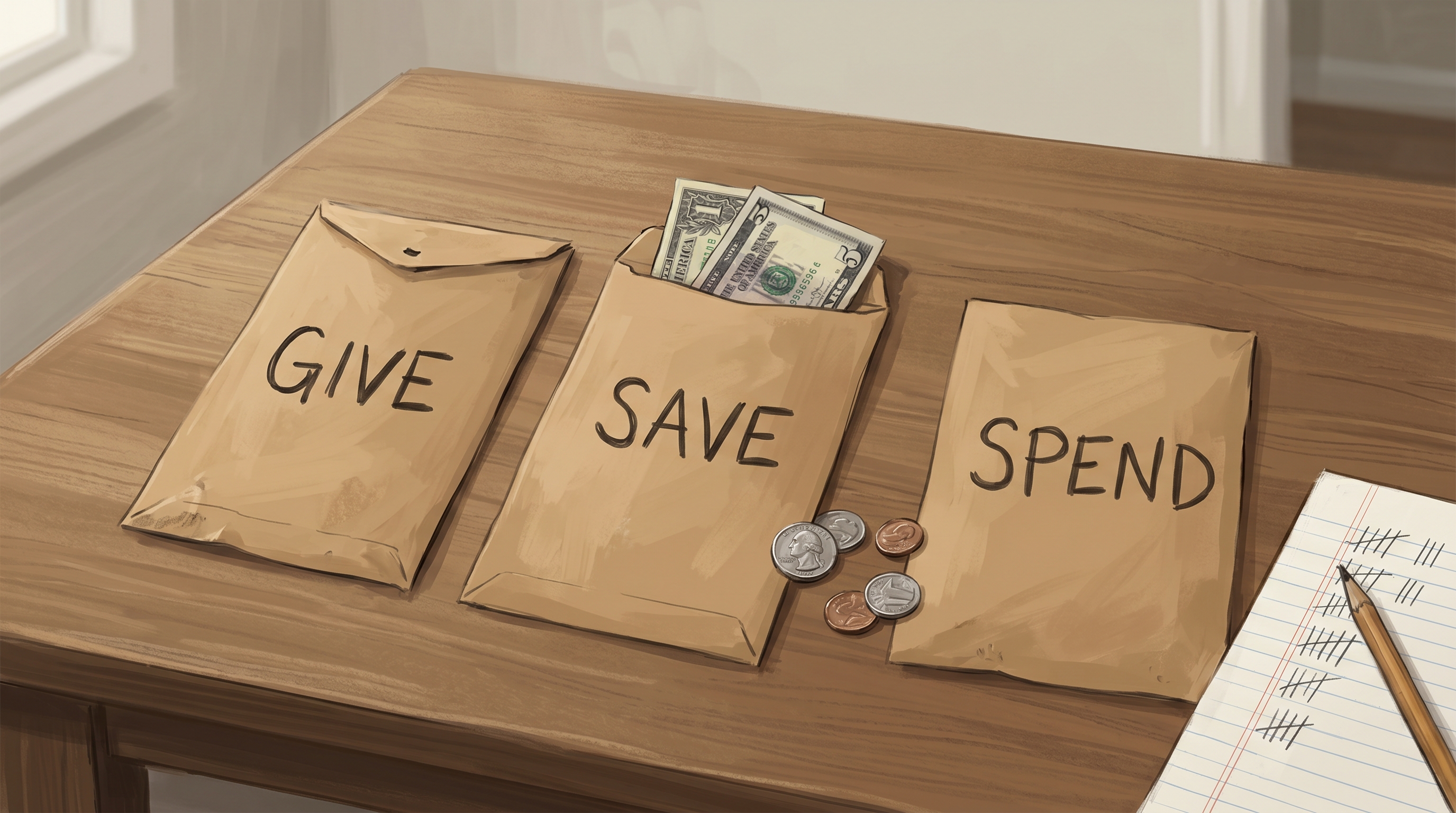
Our kid splits his weekly six dollars into three envelopes. The split is mostly his choice. Sometimes everything goes into spend (he’s saving for a Lego set, fine). Sometimes he’s motivated about a charity at school and a dollar a week goes there for a stretch. The tactic isn’t magic, and the envelopes aren’t holy. The point is the act of dividing, which is the actual financial-literacy skill.
What we got wrong
The thing we got most wrong, in retrospect, was tying everything to chores. It seemed obviously fair — you do work, you get paid — and it produced a kid who was cheerful about the system on weekends and resentful on weeknights when he didn’t feel like cleaning his room. We were rewarding compliance and calling it teaching money. The Saturday-morning “what jobs are available” conversations should have been our cue: a kid asking, before breakfast, what household labor is on the menu is a kid who has learned that this is a transactional environment.
We also undercounted how much the system was undercutting his intrinsic motivation to just… help. The first month after we decoupled, he stopped doing several things he’d been doing willingly when they were paid. The overjustification effect, in a house. It came back, but it took a while.
The thing we got most right, in the end, was naming the change out loud and letting it be uncomfortable for a few weeks. Kids absorb new rules faster than parents do. The discomfort was mostly ours.
Age-appropriate amounts, with a reality check
There’s a popular “rule of thumb” in family-money writing that a weekly allowance should equal roughly $1 per year of age. The provenance is murky. The arithmetic has not aged well; in 1995 dollars maybe, but a $7 weekly allowance for a seven-year-old in 2026 doesn’t buy what the rule originally implied. The real answer is that age-appropriate amounts depend on what you want the money to actually let your kid practice on, and what your household can afford.
A more honest framing:
- Ages 5–7: small enough that a single decision is the unit of learning. $3–$6 a week, depending on what’s in the local economy — enough that a candy bar plus a small toy is a meaningful trade-off, not enough that they can buy something serious without saving.
- Ages 8–11: enough to save for something that takes weeks. $5–$12 a week. The skill at this age is delayed gratification at a longer horizon than a five-year-old can manage.
- Ages 12+: enough that the kid is making real-budget decisions about things they’d otherwise want you to pay for. $10–$25 a week, often paired with a clearer agreement about what the allowance is now expected to cover (their phone data plan, their share of streaming, their own snacks). The skill at this age is household-finance simulation: small budget, real trade-offs.
These are ranges, not prescriptions. The specific number depends on what your family can actually afford, what costs you’re shifting to the kid, and how much practice you want them to get with money before they leave the house. The CFPB’s age-by-age milestones are a more rigorous source if you want a developmental scaffold.
The honest bottom line
Both popular camps on this question are working with partial information. The contribution camp is right that paying for ordinary household participation can erode the thing you’re trying to build. The market camp is right that money handled, not money lectured about, is what teaches kids about money.
The version that worked for us — chores everyone does because we live here; small base allowance disconnected from chores; bonus jobs for genuine extra labor — is one defensible version of the research. There are others. The specific rule matters less than the consistency, and the consistency depends on having explained the rule clearly enough that the kid (and you) know which category any given task falls into.
Pick a system. Explain it once. Stick to it long enough to evaluate. Change it on purpose rather than by drift. And if you find yourself, at 9am on a Saturday, being asked which paying jobs are available before being asked anything else, take that as a signal worth listening to.