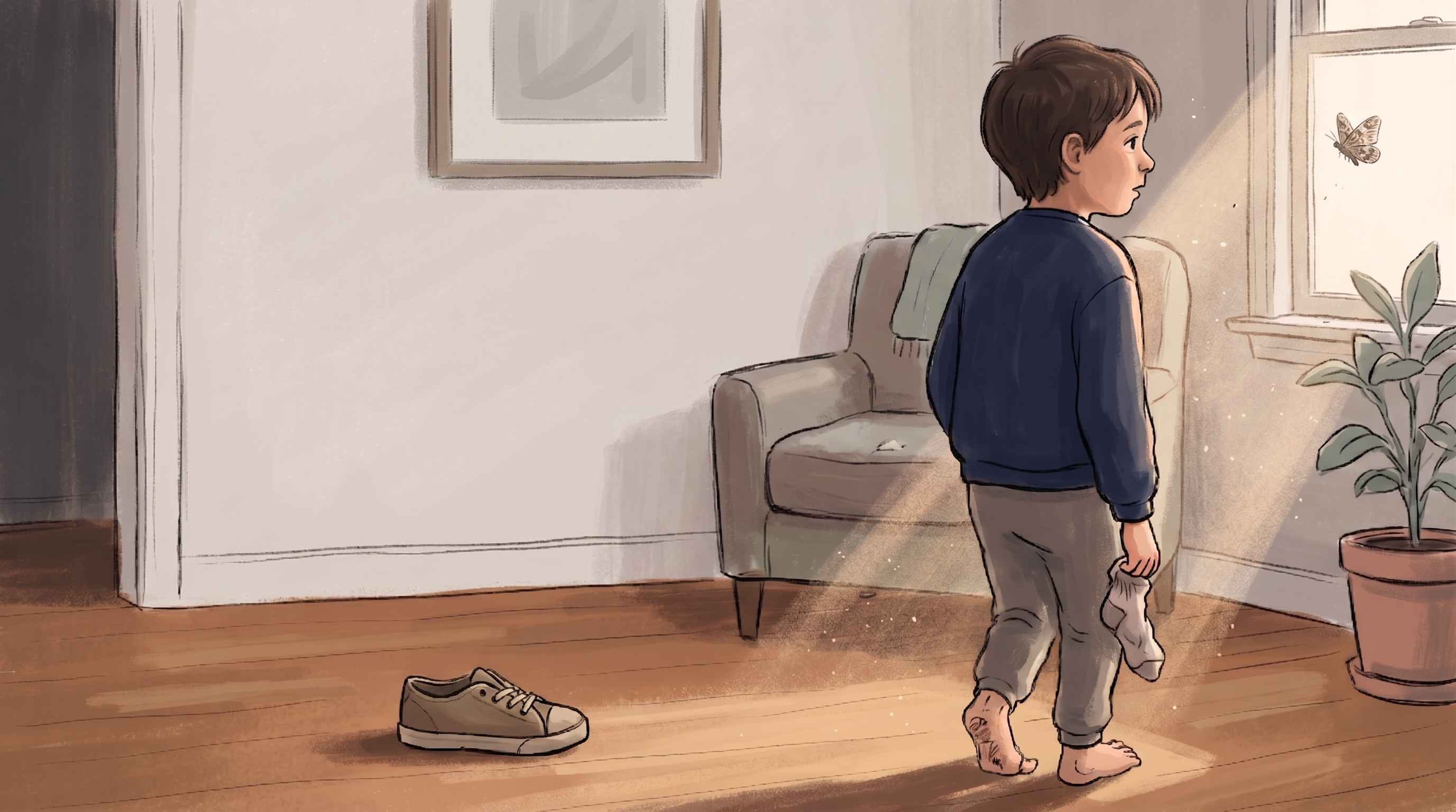
You’ve said the thing four times. Shoes. Shoes. She’s standing in the middle of the rug holding one sock and looking at the ceiling. You can feel the sentence forming in your head — she’s such a bad listener — and you’re not sure if you’re thinking it or about to say it out loud.
Don’t. Or if you do, don’t say it to her. The phrase is one of those things that starts as exasperation and ends up sticky. The kid hears it once or twice and then quietly starts to believe it about themselves, which makes the next round of shoe-related requests even worse, which gets the phrase said again. It’s a small loop, but it runs for years.
Here’s the more useful frame. Most of what we call “not listening” in school-age kids isn’t a character problem. It’s a developing brain doing exactly what brains at that age do. Once you know what’s actually happening at four, eight, and twelve, the “bad listener” reading falls apart. So does the urge to repeat yourself louder, which never works anyway.
The phrase that does the damage
Carol Dweck’s research on what she calls fixed versus growth mindsets, summarized accessibly in her book Mindset and across decades of peer-reviewed work in Child Development and Psychological Review, found that praise and labels addressed to children’s identity (“you’re smart,” “you’re a good listener”) shape behavior differently than feedback addressed to specific actions. The same goes the other way. You’re a bad listener tells the child something about who they are, not about what just happened. Kids absorb that quickly, and once a label is internalized, it gets harder to act outside it.
This isn’t a "be careful what you say" lecture. It’s a practical observation: the framing affects the next twenty interactions. You didn’t hear me when I asked for shoes is true and behavior-specific. You’re a bad listener is a character claim and not even one you’d defend if asked.
With that out of the way, here’s what’s usually happening at each age.
What four looks like under the hood
A four-year-old’s prefrontal cortex — the part of the brain responsible for planning, holding instructions in mind, and resisting distraction — is genuinely under construction. The Center on the Developing Child at Harvard summarizes the developmental neuroscience this way: executive-function skills emerge in early childhood, develop most rapidly between ages three and five, and continue maturing into early adulthood. At four, the system is online but limited. Working memory typically holds about two instructions at a time. Inhibitory control — the ability to stop doing the fun thing in order to do the not-fun thing — is roughly where adults are after three glasses of wine.
Alison Gopnik, the developmental psychologist at UC Berkeley whose work on early childhood cognition spans The Philosophical Baby and The Gardener and the Carpenter, has written for years about the specific kind of attention young children deploy. It’s diffuse on purpose. A four-year-old who appears to be ignoring you is not, in most cases, suppressing a clear adult-style focus. They’re sampling the room — the light through the window, the dust in the sunbeam, the dog’s tail, your face, the carpet pattern, your face again — in a way that’s actually developmentally adaptive. Gopnik calls this “lantern” attention, contrasted with the “spotlight” attention adults default to. Your kid is running the lantern. You’re asking for the spotlight.
What this means in practice:
- Two-step instructions max. Shoes, then jacket is a stretch; shoes alone is more reliable.
- Eye-level contact, not just calling from another room. The lantern doesn’t reach across rooms; you have to step into it.
- A 30-second wait between request and response is normal. Adults expect the response immediately. Four-year-olds need the time.
- Transitions are the hard part — not the listening itself. A kid stuck in a play state needs a warning, not a louder demand.
What eight looks like under the hood
Around six to seven, kids enter what developmental psychologists since Sheldon White’s foundational 1960s work have called the “five-to-seven shift” — a documented developmental window in which self-regulation, sustained attention, and deliberate problem-solving become genuinely accessible. By eight, your kid is meaningfully different from the four-year-old version. Working memory is wider. Inhibitory control is more reliable. The capacity for following a multi-step instruction is real.
This is also where parents start expecting too much. The eight-year-old can do it some of the time, and we read the inconsistency as defiance. It’s usually not. It’s a brain that is now capable of self-regulation and not yet skilled at it. Skill takes practice. The developmental window doesn’t hand you a finished feature; it hands you a system that needs reps.
The other thing that’s genuinely new at eight is the rise of internal motivation as a counterweight to external instruction. An eight-year-old has a richer interior life and real opinions about what they want to be doing. When you call out to them and the response is delayed, they may have heard you and decided the math worksheet they were doing was more important to finish first. From the kitchen, that looks identical to not listening. From their seat, it’s a small act of self-direction, which is the thing developmental psychology spends a lot of pages saying we want to encourage.
Practical takeaways at eight:
- Three-step instructions become realistic. Five-step is still a stretch (and is still a stretch for many adults, fwiw).
- Distinguish requests from transition warnings. In ten minutes I need you to set the table lands very differently from set the table now when they’re mid-something.
- Build in a small acknowledgment requirement. “Tell me what I just asked” is not condescending at this age — it’s an honest check on whether the request reached working memory.
- Inconsistency is the rule, not the exception. The eight-year-old who flawlessly cleans their room on Tuesday and stares blankly at the same instruction on Wednesday isn’t gaslighting you. They’re running a developing system on a tired body.
What twelve looks like under the hood
Twelve is its own situation. Lisa Damour, the clinical psychologist whose Untangled and The Emotional Lives of Teenagers have done as much as anything to translate adolescent neuroscience into ordinary language, has written extensively about what changes when puberty starts reorganizing the brain. The short version: the limbic system — the part of the brain handling emotional reactivity, reward, and novelty-seeking — matures faster than the prefrontal cortex does. So you have a kid with adult-strength emotional responses sitting on top of a still-developing executive system.
Laurence Steinberg, whose research at Temple University across decades of work in Developmental Psychology and Child Development — synthesized in his book Age of Opportunity — has framed the same neurodevelopmental asymmetry this way: early adolescence is when the gas pedal gets stronger before the brakes do. That isn’t a metaphor for risk-taking only. It also explains why your twelve-year-old can register a request, feel an immediate emotional reaction to it, and only later (sometimes much later) reach the part of the brain that decides what to do about it. The pause between request and compliance grew because the emotional layer got louder.
The other thing that’s real at twelve and worth naming: peer salience has gone through a developmental door. What friends think starts to register as urgent in a way that parental requests don’t. This is sometimes pathologized in parenting writing (“they don’t care what we say anymore”); it’s actually a developmentally appropriate, neurochemically supported reorientation that virtually all healthy adolescents go through. Your kid has not stopped loving you. Your kid is busy becoming a person who will, in some near future, leave your house, and the brain is preparing for that.
Practical takeaways at twelve:
- Don’t mistake an emotional reaction for a refusal. Twelve-year-olds often comply ten minutes after they’ve appeared to dig in. Argue less in the heat; circle back.
- Consider what you’re asking against the social cost. Asking a twelve-year-old to come downstairs for dinner during a group chat is, neurologically, a much bigger ask than it looks.
- Public requests land harder than private ones. Pulling your kid into a side conversation will fail less than calling them out in front of a sibling or a friend.
- Privilege explanation, briefly. Because I said so is a perfectly fine answer occasionally; as a primary mode at twelve, it stops working.
What “listening” actually requires
The phrase bad listener compresses four separate things into one judgment. Listening, when an adult means it, is actually:
- Attention — the request reaches a brain that’s oriented toward you.
- Comprehension — the brain parses what was asked.
- Retention — the request stays in working memory long enough to act on.
- Compliance — the brain decides to do the thing.
Most “not listening” is a failure at one of the first three, not the fourth. The four-year-old who doesn’t hear you is in attention, not compliance. The eight-year-old who heard you and forgot is in retention. The twelve-year-old who heard, processed, and is quietly ignoring you while a feeling moves through them is, in a narrow sense, in compliance, but the path to compliance is being interrupted at the emotional regulation layer that isn’t quite finished growing yet.
The point isn’t to forgive everything. The point is that diagnosing which step is failing changes what you do next. Repeating yourself louder fails because it doesn’t address attention, retention, or emotional regulation; it just adds volume.
What to try instead of repeating yourself
Ross Greene, the clinical psychologist who developed Collaborative & Proactive Solutions (free materials at livesinthebalance.org), has built a body of work around a single useful axiom: kids do well when they can. When they can’t, our job is figuring out which skill is missing rather than escalating consequences. That frame applies surprisingly well to ordinary listening problems, even if Greene’s primary work has been with kids whose challenges are more severe.
A short list of things that, in our experience and in the developmental literature, actually move the needle:
- Eye-level contact. Squat down. The request that’s ignored across the room is often heard the first time when you’re at the same height.
- One step. If you genuinely need three things done, give them in three separate moments, not as a chain. Adults find chains hard too.
- The 30-second wait. After the request, count silently to thirty. Resist the urge to repeat. Most kids respond inside that window if you don’t step on it.
- Transition warnings. Five minutes, two minutes, one minute. Kids stuck in a play state are not refusing your request; they’re mid-something. Warning lets the brain prepare for the switch.
- Acknowledge before requesting. “I see you’re building something cool. In two minutes I need you to come to the kitchen.” Naming what they’re doing first reduces the social cost of leaving it.
- Read back. “What did I just ask?” isn’t condescending past age six or so — it’s a real check on whether retention happened.
When it’s actually worth screening for something
Most of the time, what we’re reading as bad listening is developmentally appropriate. Some of the time it isn’t, and there are real conditions that hide behind that surface presentation. The point of mentioning this isn’t to alarm you. It’s to name a few signals that are worth a conversation with the pediatrician rather than another round of repeating yourself.
- Hearing. The most underdiagnosed cause of “not listening” is, sometimes, not hearing. The CDC’s Learn the Signs. Act Early. milestones note that hearing screens are routine at well-child visits, but kids who passed early can develop chronic ear-related issues that affect speech-frequency hearing. Worth flagging if your kid often asks “what?” even when they’re looking at you.
- Auditory processing. Some kids hear fine but have trouble parsing speech in noise. They look like terrible listeners specifically in busy environments (classroom, restaurant, gym) and look fine one-on-one. The AAP’s page on auditory processing walks through the signals.
- Inattentive-type ADHD. The hyperactive-type ADHD presentation is what most people picture, but inattentive-type can look almost entirely like “spaces out and doesn’t hear you.” If the pattern is consistent across multiple settings (home, school, sports) and not improving with developmentally appropriate adjustments, talking to your pediatrician about a screening is reasonable. Resources at ADDitude are reliable; the AAP’s clinical guidelines are the underlying medical document.
- Anxiety. Kids carrying significant anxiety often have less working memory available for routine instructions because their attention is allocated elsewhere. The Child Mind Institute has good parent-facing material on what childhood anxiety actually looks like (it doesn’t always look like worry).
None of these are usually the answer. But if you’ve adjusted for age, given the developmentally appropriate one-thing-at-a-time, eye-level, transition-warning version of the request and you’re still seeing a pattern that feels off — trust that instinct enough to ask the pediatrician.
The honest bottom line
Your kid’s job at four, eight, and twelve is to be developmentally appropriate. Your job is to stop reading developmental appropriateness as a personality flaw. The phrase bad listener describes the kid’s identity; what’s usually happening is a developing system, working as designed, asked to do something it can’t quite do yet at the volume and timing the adult expects.
The good news is the things that work are unglamorous and free: eye contact, one step, a thirty-second wait, transition warnings, acknowledging what the kid is doing before you ask them to stop. None of it is groundbreaking. All of it is harder than it sounds at 6:47pm when you’ve asked for shoes four times and someone is now barefoot in the entryway holding a popsicle.
Try the unglamorous things. Skip the label.