For about three years, the screen-time conversation in our house ended one of two ways: a tantrum at the iPad timer, or a quiet, slightly-shameful negotiation that resulted in twenty more minutes. Sometimes both. We had a number — ninety minutes — and we couldn’t make it stick. Worse, we couldn’t answer why ninety. We’d just half-remembered something about the AAP’s “two hours a day” rule and figured ninety was a more responsible-sounding number.
Two things changed. First, the rule we were arguing with had been retired by its own authors a decade ago, and we hadn’t noticed. Second, the rule that finally stuck in our house had nothing to do with minutes.
The number that haunts us
The American Academy of Pediatrics retired the “no more than two hours of screen time per day” rule in 2016. It’s an enduringly weird piece of public health history that most parents of school-age kids today are still negotiating with a number the relevant authority disowned ten years ago.
The current AAP guidance, articulated in two policy statements published in Pediatrics — Media and Young Minds (for kids 0–5) and Media Use in School-Aged Children and Adolescents (for kids 5–18) — doesn’t specify a daily minute count for school-age kids. Instead, it asks families to consider the content (what is the screen showing?), the context (alone or with you?), the child (this child, this temperament), and what the screen is replacing (sleep? movement? in-person time? homework?). The AAP also nudges families toward the Family Media Plan generator at HealthyChildren.org as a way to translate those principles into household rules.
That’s a much weaker position than “two hours.” It’s also a much more honest one. The AAP retired the original rule for the same reason a lot of clean public-health numbers get retired: it didn’t survive contact with the actual research literature.
What the research actually shows (and doesn’t)
The most cited adversarial finding to total-minutes thinking comes from Andrew Przybylski at the Oxford Internet Institute. His 2017 paper in Psychological Science, using a sample of more than 120,000 UK adolescents, proposed what he called the “Goldilocks hypothesis”: moderate use of digital screens is not harmful and may even be slightly associated with positive outcomes, while only the very-low and very-high ends of the distribution show adverse associations. Crucially, the size of the effects he could detect was small — smaller than the effects of, say, eating breakfast regularly or getting enough sleep.
Candice Odgers, a developmental psychologist at UC Irvine who has been one of the more measured voices in this discourse, has argued in Nature and elsewhere that the alarmist screen-time-causes-everything literature suffers from chronic methodological problems — cross-sectional designs, tiny effect sizes presented as catastrophic, an over-reliance on self-reported screen use that doesn’t match objective measurement.
On the other side, Jonathan Haidt’s The Anxious Generation (2024) has been doing a lot of work in the public conversation. Haidt argues that the smartphone-based childhood is the primary driver of the post-2012 adolescent mental-health decline, and the book has reshaped a lot of household conversations and at least one wave of school phone bans. It’s worth reading. It’s also worth pairing with Odgers’s critical Nature review of the same book, which lays out the methodological caveats that the bestseller doesn’t foreground. Both are real arguments. Treating either as settled science is the mistake.
Sonia Livingstone’s long-running EU Kids Online research at the London School of Economics has spent two decades documenting what kids actually do with screens cross-nationally. The consistent finding: the meaningful variable is what the screen is used for and what gets crowded out, not how many minutes the screen is on. A kid using a tablet for an hour to make stop-motion videos with a friend is doing something different from a kid scrolling alone on YouTube for the same hour, and the developmental literature has been saying so for a while. Minute-counting flattens the difference.
None of this means “screens are fine, relax.” It means the actual story is more nuanced than either the moral panic or the tech-positive contrarianism wants to admit, and most of the household pain is downstream of trying to enforce a rule whose underlying research base is shakier than the parents enforcing it realize.
Why minute-counting fails as a household rule
Even if you were confident in a specific number, minute-counting fails as a household operating system. Three reasons:
The cliff at the end. A timer-based rule turns the last five minutes into a frantic scramble (one more level, one more video, one more) and the moment the timer fires into a felt loss. That emotional charge is what creates the tantrum. The screen didn’t do it; the rule structure did.
It makes screens more salient, not less. A scarce thing is interesting. Treating screens as a precious resource doled out in increments often produces a kid who thinks about screens more, not less. This is something Devorah Heitner names in Screenwise and expands on in Growing Up in Public: families who manage their kids’ digital lives largely through restriction tend to produce kids who have not built any internal capacity to put it down.
It conflates very different uses. Twenty minutes of FaceTiming a grandparent is not the same as twenty minutes of TikTok. A flat number doesn’t distinguish them. So either the rule applies dumbly to everything (and creates conflict around uses parents don’t actually want to limit) or it has so many exceptions that it stops being a rule.
The frame that worked for us
What actually changed our house was switching the question. Instead of how many minutes, we started asking what is the screen replacing.
We landed, embarrassingly, on a four-bullet list that we wrote on a whiteboard and called the 4S filter:
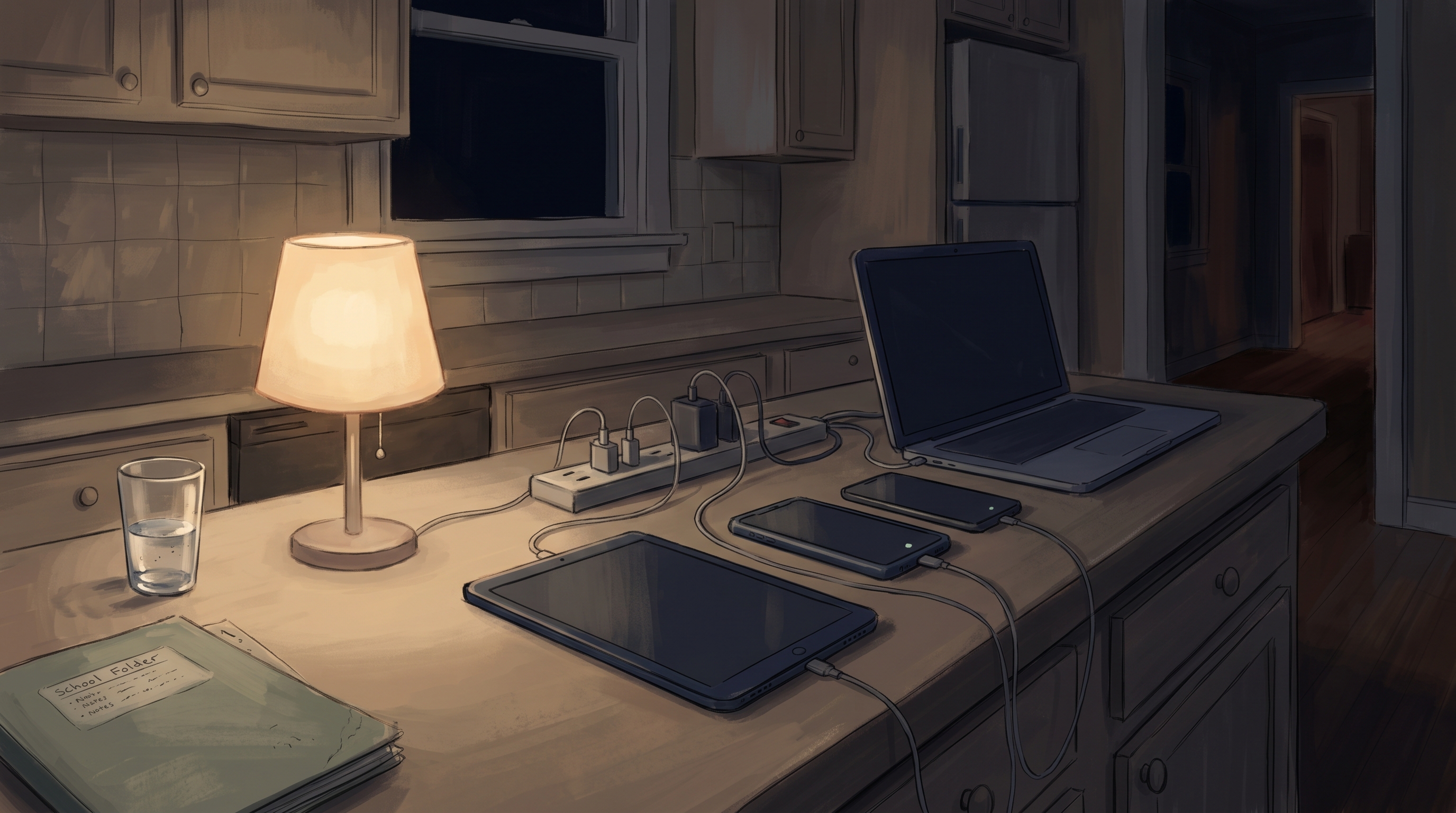
Sleep. No screens after 8:30pm on school nights. Devices charge in the kitchen, not in bedrooms. This is the only minute-adjacent rule we still have, and it’s really a sleep rule, not a screen rule.
School. Homework done first. Not because homework is sacred, but because nothing else gets done after the screen comes on, in our kid, on most days. Yours may be different.
Social. If a friend is over, the screen goes off (or becomes a shared activity, in which case it’s often fine).
Sweat. Some daily movement — a walk, a bike ride, a soccer practice, anything. It doesn’t have to be much. It just has to happen.
If those four are intact, we don’t count minutes. Some weekend afternoons our kid is on the iPad for two hours making something he’s proud to show us, and that’s fine. Some weekdays he gets twenty minutes and resents it because the homework was hard and the violin practice was longer than usual, and that’s also fine. The conversation about “more” is rare now, because the rule isn’t a quota.
A note on this: the 4S filter is something we landed on for a particular kid in a particular house. We are not claiming it’s the rule. The frame that’s research-backed is that what the screen replaces is the right thing to evaluate; the specific operationalization will look different in your house. The point of writing it down was that the act of writing it down stopped the nightly negotiation.
The conversations that matter more than the rules
Devorah Heitner’s consistent argument across her two books and her ongoing work is that mentorship beats restriction. Co-viewing — sitting next to your kid while they watch the show, occasionally asking what they think about it — does more for media literacy than time limits do. Asking what made you laugh just now or did that look real to you trains a kind of critical attention to the screen that quietly extends past the moment you’re sitting there.
Jordan Shapiro’s The New Childhood takes a similar position from a different angle. The kids who handle screens best are the ones whose parents engaged with the screen as a co-experience — played the game with them, watched the show, talked about what they were seeing — rather than treating it as a thing to be parceled out.
Practically, this means: if you can stomach watching the YouTube channel your kid likes for fifteen minutes and asking real questions about it (not interrogating; questions an interested adult would ask), that fifteen minutes does more than an hour of negotiating over time limits. We didn’t love this finding. It costs more energy than enforcing a number. It also works.
The phone question, briefly
The smartphone question for school-age kids is its own thing, and the discourse around it is currently overheated in both directions. A few things that, in our reading, are actually defensible:
- Smartphone before about age 14 is associated, in the available evidence, with worse outcomes than later acquisition — but the effect sizes are smaller than the bestsellers suggest, and the “social media” piece is doing more of the work than the “phone” piece. A flip phone or a lockable kid phone doesn’t carry the same risk profile as an unlocked iPhone with Instagram.
- The strongest evidence of harm is for early-adolescent girls and Instagram/TikTok specifically, in heavy-use patterns. This is the piece of the Haidt argument that survives critical review most cleanly.
- Group decisions help. The Wait Until 8th pledge — a parent network committing to no smartphones until at least 8th grade — works because it solves the “everyone else has one” coordination problem that makes individual delay so hard.
- The Common Sense Media reviews are the best parent-facing tool we’ve found for evaluating specific apps, games, and platforms before the kid encounters them.
What the family media plan actually looks like in practice
HealthyChildren.org’s Family Media Plan generator is genuinely useful, even if the AAP’s tone in it is a touch officious. It walks you through screen-free zones (the dinner table, bedrooms), screen-free times (during meals, the hour before bed), kinds of media that are okay without supervision versus kinds that need a parent in the room, and behavior expectations around devices. It produces a printable PDF.
We used it. We kept maybe sixty percent of what it suggested. The thing it actually did was make the rules concrete enough that we stopped re-litigating them every night. Whether you use the AAP’s tool or a whiteboard, the operative variable is that the rule lives outside your head — written down somewhere both adults and kid can point to. Negotiation collapses when there’s a piece of paper involved.
The honest bottom line
The AAP’s old “two hours” rule was retired because it didn’t hold up under scrutiny. Most of the alarmist screen-time-causes-everything literature doesn’t hold up either. Most of the tech-positive contrarianism understates the real concerns — especially around social media for early-adolescent girls and smartphones in general. The honest middle is messier than either bestseller wants to admit.
The goal of a screen-time rule isn’t a number. It’s a kid who can put a screen down without a tantrum, talk with you about what they were just watching, and eventually notice on their own that something on a screen made them feel weird. None of that is measured in minutes.
Pick a frame. Write it down. Stop fighting last decade’s rule.